One record, better care: Powys Teaching Health Board enhancing medicines safety for patients
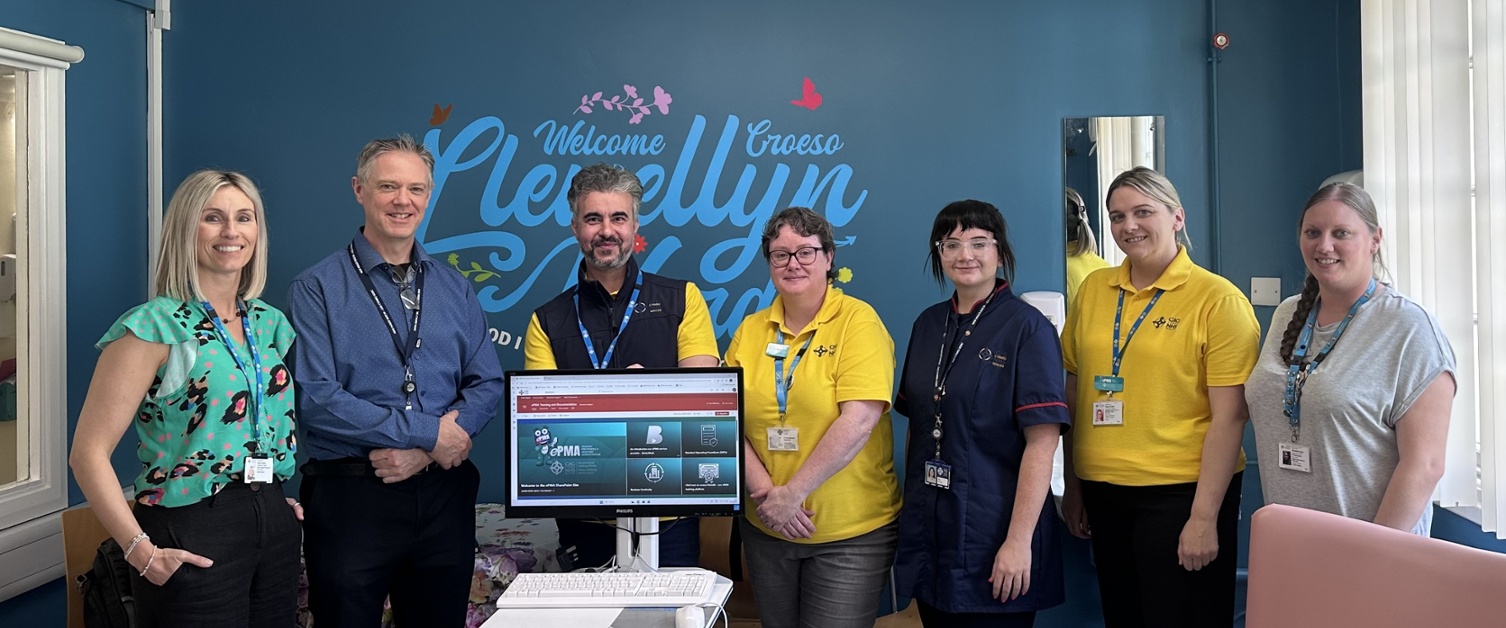
L-r: Sue Hamer (Head of Digital Programmes), James Goddard (Hospital e-Prescribing lead, DHCW), Mo Abdelkafi (Principal Pharmacist), Bethan Perry (Senior Pharmacy Technician), Ffion Thomas (Senior Clinical Informatician, DHCW), Emma Dodge (Informatics Clinical Nurse Specialist) and Elizabeth Davies (Product Specialist)
28 May 2026
Powys Teaching Health Board (PTHB) have become the first health board in Wales to start both reading medicines on hospital admission and writing discharge medicines with the Shared Medicines Record (SMR), marking a significant step in helping to create a consolidated medicines record for patients.
Bronllys Community Hospital in Brecon have started their transition from paper charts at the bedside to the electronic Prescribing and Medicines Administration (ePMA) from supplier, Better, making prescribing easier and safer for patients and for healthcare staff managing their medication. This marks the beginning of their wider digital journey as they also start their implementation of a full read and writing of medicines with the SMR.
The SMR is a key component of the national Digital Medicines Programme managed by Digital Health and Care Wales (DHCW). It is a consolidated and shared record of medicines, allergies and intolerances for every patient in Wales. This allows healthcare professionals to access the information they need without a patient having to provide the same details every time they see a new member of staff. It helps support clinical decisions and reduce risk when care is transferred from one point to another.
Holly Jarman, Pharmacy Technician at PTHB, noted: “Since using ePMA on my ward there are already clear benefits to both staff and patients. The system has improved the way we work on the ward by allowing multiple healthcare professionals to access a patient’s drug chart at the same time, reducing delays, and improving communication between pharmacy, nursing, and medical staff.
“Due to the rural nature of Powys, ePMA is valuable in supporting remote working to review medication charts and facilitate discharge.
“The pharmacy priority list has also improved workflow by helping identify newly admitted patients, medication changes, and those requiring urgent clinical review. This supports safer prescribing, more efficient medicines management, and timely patient care”.
Sue Hamer, Head of Digital Programmes at PTHB, said: “I am excited that we are now beginning the implementation of ePMA on our inpatient wards. Reaching this point is a real milestone, and I’m incredibly proud of the hard work, commitment, and collaboration that staff have shown along the way. It’s been a privilege to be part of this journey, and I’m excited about the difference ePMA will make for both staff and patients as we continue to improve the safety and quality of care at Powys Teaching Health Board”.
Dr Lesley Hewer, DHCW Chair of the National ePMA Programme, said: “It was great to see first-hand the implementation of the ePMA system at the Llewelyn ward in Bronllys Community Hospital. I was impressed with how the staff took it in their stride; with the extensive amount of time, effort and preparation the team had done being evidently worthwhile.”
“Powys is such a vast geographical area with some staff attending the clinical environment 2-3 times a week, so by proving remote access capabilities with the new system, it is clear to see the time saving benefits this new system will provide.”
“It is exciting to see the SMR read and write functionality starting to be used within PTHB. You can see the potential for this in Wales as being a gamechanger; the jewel in the secondary care e-PMA implementation.”